
Today Nicolas is out with his friend Julian. It is grey in Basel and Zurich, but the sun is forecast to shine in Graubünden. That is where we hope to see the yellow larch forests.
At 7:04 am we take the IC from Basel SBB to Zurich. There we have breakfast and buy sandwiches for the journey. At 8:38 am we continue to Chur, and at 9:58 am we board the Rhaetian Railway train towards St. Moritz. From Thusis it runs on the Albula Railway, which has led into the Engadine since 1903 and has been a UNESCO World Heritage Site since 2008.
Over the Landwasser Viaduct
The ride to Bergün is very beautiful. Just before Filisur the train crosses the Landwasser Viaduct. It is 65 metres high and 142 metres long and ends directly in a rock face, where the line disappears into the Landwasser Tunnel. Because the viaduct lies on a curve, we can see through the window the locomotive entering the tunnel up ahead and our own carriages above the piers behind.
The locomotive carries a picture of a long red train on a viaduct on its side and the words «Weltrekord-Fahrt 29. Oktober 2022», world record run, 29 October 2022. On that Saturday the Rhaetian Railway set a world record here, according to Guinness World Records with the longest narrow gauge passenger train. Twenty-five trainsets with 100 carriages between them, 1906 metres long, rolled from Preda to Alvaneu.
At 11:12 am we arrive in Bergün, at 1373 metres. Right after we get off, a tree glows orange in the sun.
At the edge of the village towards Preda the Bergün vitaparcours begins, a fitness trail of 2.6 kilometres with 15 stations for strength, mobility and endurance. Our path follows it for a while. On the rings we do pull-ups, on the wooden parallel bars triceps dips, then we carry on into the forest.
Along the viaducts to Preda
From Bergün to Preda the Bahnerlebnisweg Albula, a railway trail with information boards about the line, runs alongside the tracks. Between the two stations there is a difference in height of 416 metres and a little over five kilometres as the crow flies. So that the gradient never exceeds 35 per mille, the railway winds its way over twelve kilometres through two horseshoe tunnels and three spiral tunnels and crosses the Albula on four viaducts.
Just after half past twelve a red train crosses the low Albula Viaduct I, with the road passing under its arch. In front of it the road crosses the Albula on a stone bridge. Further up the path leads through larches and spruces, and beside the path the stream rushes over the stones. The larches are already yellow. The larch is the only native conifer that turns yellow in autumn and sheds its needles, and according to the Graubünden tourist board its colour is most vivid around mid-October.
Just after one a completely different train comes over the tall Albula Viaduct III, at 138 metres the longest of the four. Behind a locomotive in blue and ivory come the «Gourmino» dining car from the 1930s, more blue carriages, a carriage of brown wood and a yellow open observation car.
Not quite half an hour later another red train crosses the Albula Viaduct IV, high above the gorge.
Below Preda the valley flattens out. A stream flows through a plain of dry grass, and above the forest stand two pointed mountains, on the left the pyramid of Piz da las Blais, on the right the Dschimels with its double summit. Its name comes from the Romansh word for twins. In the forest after that we spot a fly agaric among the needles.
At Lai da Palpuogna
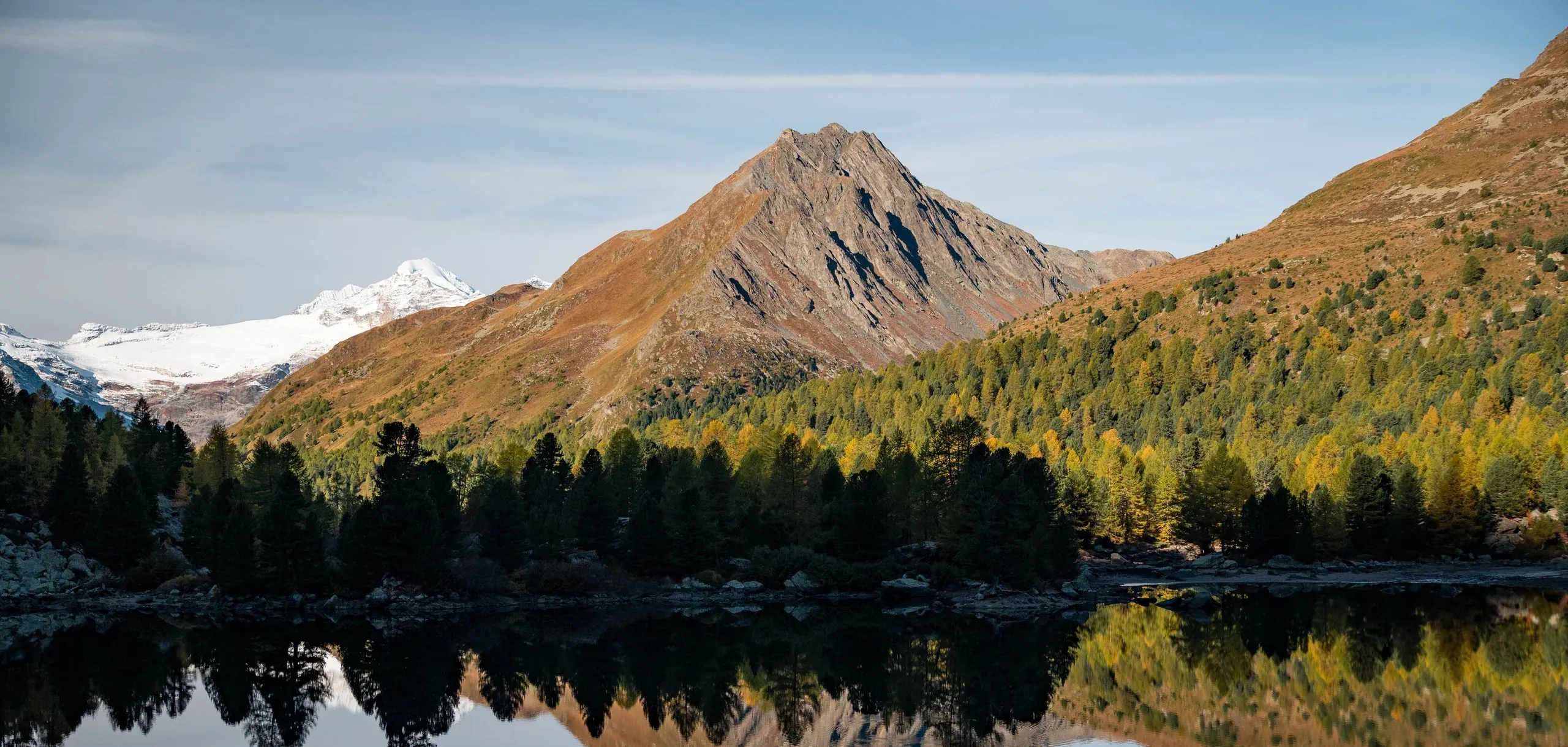
From Preda, where the railway disappears into the Albula Tunnel at 1789 metres, the path continues up to the lake, which lies almost 130 metres higher. Shortly before half past two we stand at the north-western end of Lai da Palpuogna, Palpuognasee in German. Except for its south-eastern end it already lies in the shadow of Piz Palpuogna, which rises to the south-west above the lake. The still water reflects the yellow larches and the peaks, and near the shore we can see the stones on the bottom.
The lake lies at 1918 metres and is about 500 metres long. In 2007 it was voted the most beautiful place in Switzerland in a poll by the Swiss TV channel SF 1. Since 1898 it has supplied water to the power station in Preda, which first generated electricity for building the Albula Tunnel. Swimming is not allowed. This is where Mika, another friend of ours, sank his drone in 2024. It is probably still lying on the bottom.
There are still two hours until our train leaves. We add a loop and walk on from the lake up the valley to Crap Alv, where the road to the Albula Pass crosses the Albula. East of the lake we pass a fen meadow with golden grass and a stream between shrubs in autumn colours. Down the valley we can see Piz Ela. It is 3339 metres high and gives its name to Parc Ela, which the lake is also part of. Alp Weissenstein, a research station of ETH Zurich, stands at Crap Alv. We turn round on the bridge over the Albula. On the way back we take a meadow path above the pass road and a path across the meadow to the car park by the lake, and from there we walk down to Preda. With the loop it is almost five kilometres from the lake to the station.
Shortly after four we are back at Preda station. Behind the wooden station building two portals lead into the mountain. The track runs into the left one, construction vehicles stand in front of the right one. The new Albula Tunnel opened in June 2024, and the old one from 1903 is being converted into a safety tunnel. At 4:29 pm we take the train to Chur and from there the IC to Zurich.
At 7:24 pm we arrive at Zurich main station. Before our train to Basel leaves, we go to mit&ohne, the döner that Gault&Millau called «Zürichs Hype-Döner», Zurich’s hype döner, in 2024. As well as the restaurant at Lochergut, it has had a branch in the main station since summer 2025, in the Löwenstrasse hall by the stairs down to platforms 31 to 34. There are a lot of people, and eight staff are working. Nicolas orders the vegan Vegiboss Kebab for just under 18 Swiss francs. We see for ourselves that the bread is baked fresh here. The döner is very good, for us the best so far in Switzerland.
At 7:58 pm we continue on the IC and are in Basel at 8:58 pm. It has rained here almost all day. MeteoSwiss measures about 20 millimetres of rain at Basel-Binningen and no sunshine, while we enjoyed the sun in Graubünden.
Comments
Questions, tips or just a hello: We are happy about every message.