
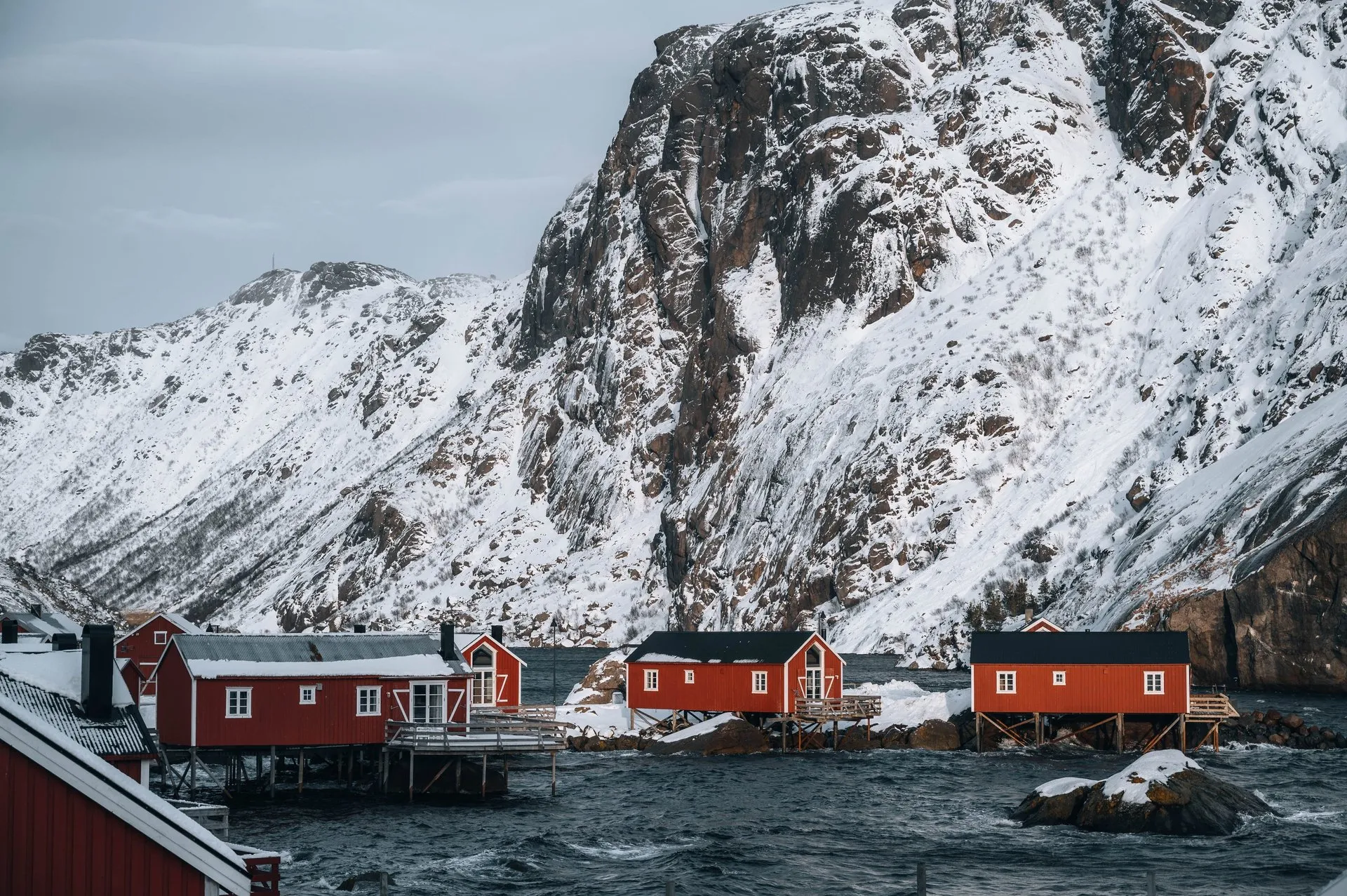
This morning it is time to pack up again and clear out the rorbu, because we are moving on to our next accommodation. We have spent five nights in our little cabin at the harbour of Hamnøy. After checking out we first drive to Å, in (finally) fine weather, and explore the last fishing village that can be reached by car. We were here once before, after climbing Reinebringen, but that was in the late afternoon and shortly before it started to rain again. By the harbour the red fishing houses stand on stilts, white boats lie in front of them, and behind them rise a steep mountain and a jagged ridge.
Å lies on the Vestfjord in the south-east of the island of Moskenesøya and is the outermost settlement on the large islands of the Lofoten. The name comes from the Old Norse á, ‘river’, and was originally the name of the Åelva, which flows only a short way from a lake into the Vestfjord. An ensemble of buildings from the middle and the end of the 19th century has survived, among them a cod liver oil works from 1850, a bakery from 1844 and several rorbuer. The Norsk Fiskeværsmuseum, the Norwegian Fishing Village Museum, is housed in these buildings and tells of life in the fishing village and of the Lofoten fishery.
Here we see a few sea eagles again! We already saw some on the drive to Hamnøy, and near Fredvang one circled above us. The sea eagle, or white-tailed eagle, havørn in Norwegian, is Norway’s largest bird of prey and has a wingspan of 200 to 240 centimetres. About 60 per cent of the Norwegian population breeds in the three northernmost counties. Its most common prey is fish and seabirds.
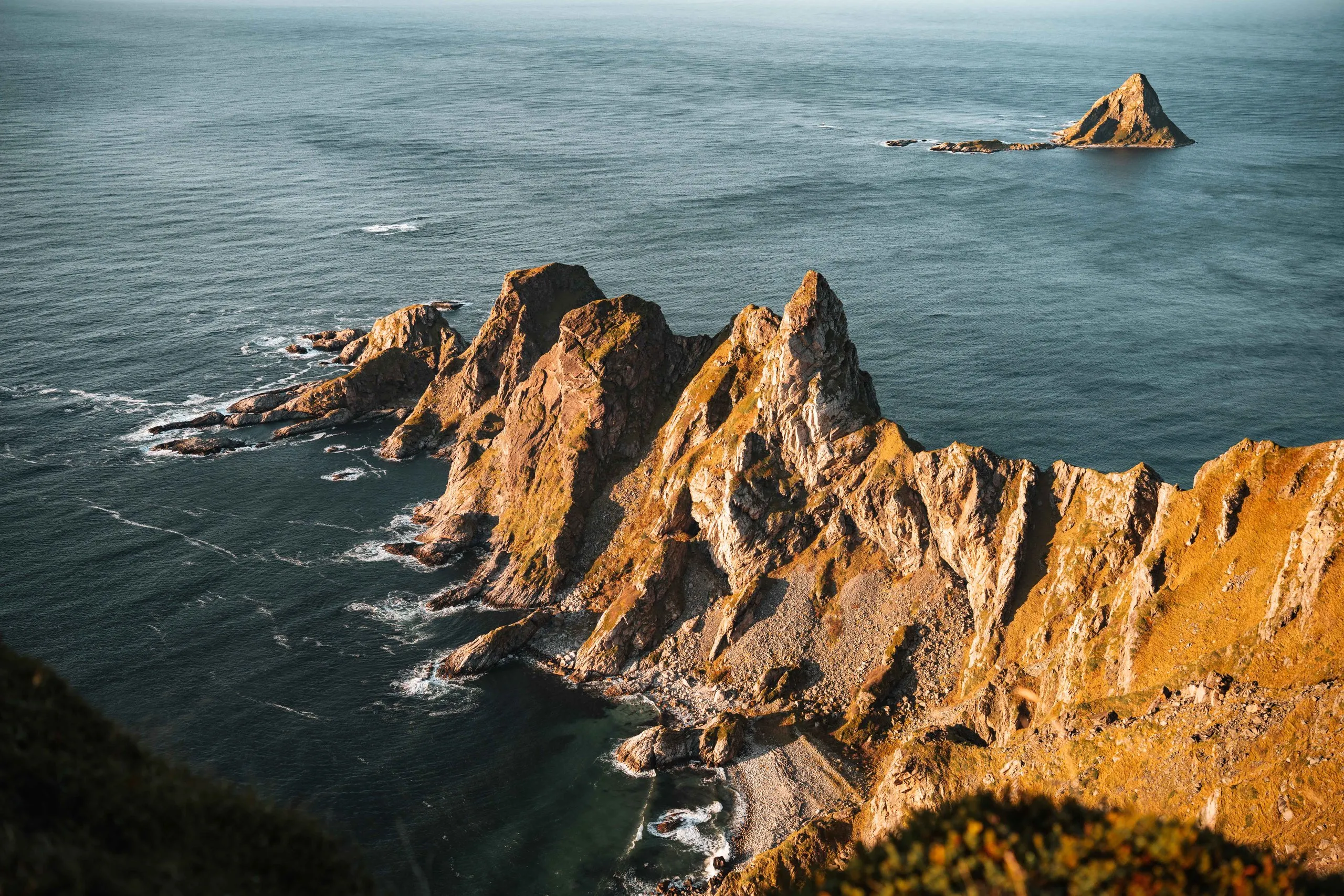
We also return to the viewpoint overlooking the mountains and the sea. From the large car park where the E10 ends, a path leads to the cliffs at the outermost edge of the village. Yellow and red grass grows on the rock slabs, and the cliffs drop steeply into the deep blue sea. South-west of Å, between Lofotodden at the outermost tip of Moskenesøya and a few islets north of the island of Mosken, lies the Moskstraumen. This tidal current, a little over four kilometres wide, already appears in Edgar Allan Poe and Jules Verne, who relied on older and greatly exaggerated accounts.
But then the weather changes very abruptly. A rainbow briefly announces the rain, and the next moment we are caught in another heavy downpour. Annina is almost blown away by the wind, so we quickly retreat to the shelter of the car and set off for our next accommodation. It is only a 10-minute drive from the previous one, further north towards Ramberg.
On the E10 we pass Sakrisøy and Hamnøy once more. Before we can check in, we buy the groceries we need at the nearest shop. We stop at a few viewpoints again, but mostly all we see is fog and rain. Unfortunately there is little point in hiking in this weather. We try again the next day, first on Nubben near Ramberg and then on the way to Kvalvika Beach.
So we drive to our new accommodation and look forward to getting warm. It is part of the Lofoten Cabins Kåkern, a row of newly built, modern little red fishing houses. Our little house is right by the sea, with a view of the mountains.
Inside everything is very modern and bright, with huge windows facing the sea and the mountains. First, the sofa right in front of the window invites us to read and edit photos in comfort. Before we make potato gratin and salad in the evening, we also fit in a workout. Over the next few days we even spot a seal in the bay in front of the cabin through the big window facing the sea.
Comments
Questions, tips or just a hello: We are happy about every message.